There’s a conversation we have with almost every new client, usually early in the first meeting, before we’ve touched a pencil or opened a laptop. It goes something like this: they’ve been researching energy-efficient homes, they’ve read about Passive House, they’ve looked at solar panels and geothermal systems and triple-pane windows, and now they want to know, how do we make this home as efficient as possible?
It’s a great question. But the answer almost always surprises them.
The most powerful energy efficiency decisions you’ll ever make about your home aren’t the ones you make at the end of the process. They’re not the ones you make when you’re picking mechanical systems or choosing insulation products. They’re the ones you make at the very beginning, before the floor plan exists, before the foundation is located, before a single wall is drawn. They’re decisions about orientation, about massing, about window placement, about how the building sits on the land and relates to the sun and the wind and the slope beneath it.
That’s what this piece is about. Not the products. Not the systems. The decisions that happen on day one, and why getting them right changes everything that comes after.
We’ve been practicing Hudson Valley residential architecture long enough to know that the homes that perform best over time, the ones that are genuinely comfortable, genuinely efficient, and genuinely beloved by the people who live in them, are the ones where energy was treated as a design principle, not an afterthought. Not a checklist item to hand off to an energy consultant at the end. Not a retrofit to consider after the framing goes up. A core value, present in every decision from the first sketch to the final walkthrough.
We want to share how we think about that process, and why it matters so much in a climate like upstate New York’s.
The Problem With Retrofitting Efficiency
Before we talk about what to do, it’s worth understanding what not to do, and why so many well-intentioned projects fall short of their energy goals.
The most common pattern we see goes like this: a client designs a home the traditional way, working from a floor plan they love, locating it on the site according to setbacks and views and driveway convenience. Then, somewhere in the construction documents phase, or worse, after construction has started, someone asks about energy performance. And the answer at that point is always the same: we can add insulation, we can upgrade the windows, we can specify a better mechanical system. But we can’t undo the fundamental decisions that were already made.
A home that faces the wrong direction can’t be reoriented. A home with a sprawling footprint can’t be made compact. A home with too much glass on the west elevation can’t be easily shaded. A home with a complicated roofline has already created the thermal bridging and air sealing challenges that will haunt it for decades.
This is the retrofitting trap. It’s expensive, it’s limiting, and it produces homes that perform adequately at best, not homes that perform beautifully.
We design our energy-efficient house plans to avoid this trap entirely, by treating efficiency as a design discipline from the moment we begin.
Step One: Reading the Site
Every project we take on starts with a serious, unhurried reading of the site. Not just a visit, a study. We want to understand the land the way the building will have to understand it, every day, for the next hundred years.
In the Hudson Valley and Ulster County, sites are rarely simple. You might be working with a steeply sloped parcel in the Catskill foothills, where the building needs to step with the topography to avoid massive retaining walls and where the drainage patterns will determine where the foundation can safely go. Or you might be on a flat, open meadow parcel near the river, where the wind exposure is significant and the frost depth matters for foundation design. Or you might be in a wooded lot where the tree canopy shapes the solar access in ways that need to be carefully mapped.
We look at all of it. Solar path analysis, where the sun rises and sets in different seasons, how it angles across the site, where shadows fall from trees and ridgelines and neighboring structures. Prevailing wind direction, which in our region tends to come from the northwest in winter and the southwest in summer, and which has real implications for where you locate entries, how you design overhangs, and how you think about natural ventilation. Drainage and hydrology, because a home built without understanding where water flows is a home that will fight its site forever.
We also look at the views, not just where they are, but where they pull the design. Some of the most beautiful views in the Hudson Valley face north or west. That’s fine for a window seat or a porch. It becomes a problem if the whole house gets oriented toward the view at the expense of solar access, because then you’re fighting physics every January for the life of the building.
None of this analysis is exotic or expensive. It’s what thoughtful site-responsive architecture has always required. But it has to happen before the design begins, not after.

Step Two: Orientation as a Performance Decision
Once we understand the site, orientation becomes one of the most consequential design decisions we make. And it’s one of the least expensive, you don’t pay more to orient a building correctly. You just have to do it before the floor plan locks in.
The basic principle is straightforward: in our climate, the long axis of the building should run roughly east-west, with the primary glazing on the south elevation. This captures low-angle winter sun, which brings free heat into the home during the coldest months. The north elevation gets minimal glazing, because north-facing glass loses heat without providing meaningful solar gain. East and west elevations get selective, carefully shaded glazing, because east and west exposures can cause summer overheating if not managed.
This is passive solar design in its most fundamental form, and it costs nothing if it’s incorporated from the beginning. If it’s ignored, no amount of insulation or mechanical upgrades will fully compensate.
We’ve worked on sites where the obvious building location, the flat spot, the area with the best driveway access, the corner of the lot closest to the road, faced the wrong direction. In those cases, we have a conversation with our clients about what it would take to shift the orientation, whether that means rethinking the driveway, accepting a slightly different relationship to the property line, or reconsidering which face of the building is the “front.” Those conversations are sometimes uncomfortable. They’re almost always worth it.
The U.S. Department of Energy’s Green Building Guidelines are consistent on this point: passive solar orientation is one of the highest-return energy strategies available in cold climates, and it’s most effective when integrated at the earliest stages of design.
Step Three: Massing and Compactness
After orientation, massing is the next major lever. Massing refers to the overall three-dimensional form of the building, how it’s shaped, how complex its geometry is, how much surface area it exposes to the exterior relative to the volume it encloses.
This matters for a simple reason: every square foot of exterior surface is a place where heat can escape. The more surface area a building has relative to its interior volume, the harder it has to work to stay warm in winter and cool in summer. A simple, compact building form is inherently more energy-efficient than a sprawling, complex one, before you even begin to think about insulation levels or mechanical systems.
This doesn’t mean every energy-efficient home has to be a box. It means that every departure from a simple form has an energy cost, and that cost should be a conscious design decision rather than an accidental consequence of adding bump-outs, wings, and architectural complexity without thinking about the thermal implications.
In our custom home design services, we work through massing with our clients early and honestly. We show them what different configurations mean for surface-to-volume ratios. We talk about where complexity adds real value, spatial variety, light quality, connection to the outdoors, and where it adds cost and energy penalty without meaningful benefit. These conversations shape buildings that are both beautiful and sensible.
A project we worked on near Woodstock illustrates this well. The clients came to us with a program that, if realized in the traditional rambling farmhouse style they initially envisioned, would have produced a building with significant thermal complexity, multiple rooflines, a long connector between the main house and a guest wing, a wraparound porch that would have shaded the south elevation in winter. We worked through the massing with them over several design sessions, finding a configuration that preserved the spatial generosity they wanted while producing a much cleaner thermal envelope. The final home was more compact, more efficient, and, we’d argue, more architecturally coherent than the original vision.
Step Four: The Envelope Before the Systems
Here’s a principle we come back to constantly, and one that shapes every project we design: optimize the envelope before you size the systems.
The building envelope, the walls, roof, foundation, windows, and doors, is the primary determinant of how much energy a home needs. If the envelope is excellent, the mechanical systems can be small, simple, and inexpensive. If the envelope is poor, you’re compensating with large, expensive, energy-hungry mechanical systems that still won’t make the home as comfortable as a well-built envelope would.
This is the logic behind Passive House design, which several members of our team are PHIUS Certified Passive House Consultants and Certified Passive House Tradespeople to deliver. Passive House buildings are so well-insulated and so tightly sealed that their heating and cooling loads drop to a fraction of what a code-built home requires. In some climates, a Passive House can be heated with nothing more than a small electric resistance element, the mechanical system almost disappears because the envelope does all the work.
In the Hudson Valley, we’re rarely in a climate where mechanical systems disappear entirely. But the principle holds: invest in the envelope, and the mechanical systems become smaller, cheaper, and more reliable. Neglect the envelope, and you’re spending money on mechanical equipment forever.
What does a high-performance envelope look like in practice?
Insulation levels well above code minimum. In our climate, we typically target R-40 or better in roofs and R-25 to R-30 in walls, achieved through combinations of cavity insulation and continuous exterior rigid insulation that eliminates thermal bridging through the framing.
A continuous, verified air barrier. Air sealing is arguably more important than insulation in cold climates, because a small gap in the air barrier can move more heat than a large area of under-insulated wall. We detail air barriers explicitly in our drawings, we don’t leave them to the contractor’s judgment, and we verify them with blower door testing after construction.
High-performance windows, carefully placed. Triple-pane windows on key exposures, with appropriate U-values for our climate zone, installed with meticulous attention to flashing and air sealing at the rough opening.
A thermally broken foundation. In new construction, we design foundations with continuous sub-slab insulation and exterior foundation insulation to eliminate the cold bridge at the base of the building, a detail that’s frequently overlooked and frequently regretted.
Step Five: Daylighting and Ventilation as Design Tools
Energy efficiency isn’t only about keeping heat in. It’s also about minimizing the need for artificial lighting and mechanical ventilation by designing the building to work with natural light and air.
Daylighting, the deliberate use of natural light to illuminate interior spaces, reduces electrical loads and improves the quality of interior environments in ways that are genuinely hard to replicate artificially. A well-daylit home feels alive and connected to the outside world in a way that a artificially lit home simply doesn’t. It’s also measurably better for health and wellbeing, a fact that’s well-documented in the building science literature.
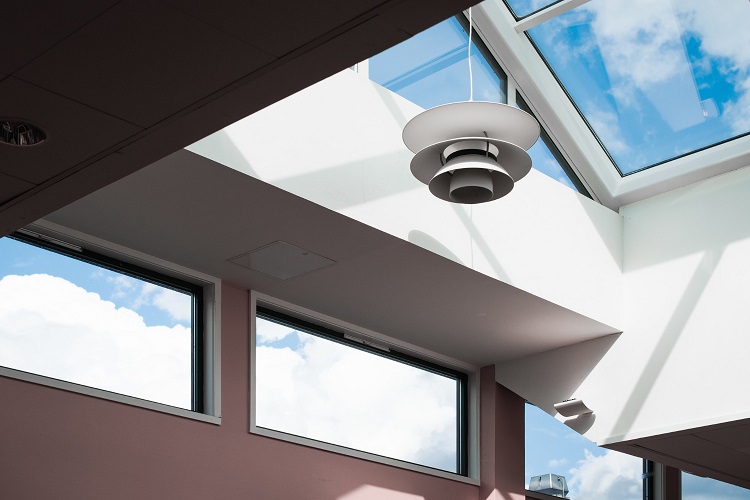
We design for daylighting by thinking carefully about where windows go, how they’re sized, how light penetrates into the depth of the floor plan, and where clerestories or skylights can bring light into spaces that couldn’t otherwise receive it from the walls. We also think about glare control, south-facing windows need overhangs sized to block high summer sun while admitting low winter sun, and those overhangs need to be calculated, not guessed.
Natural ventilation is equally important, particularly in the Hudson Valley’s warm, humid summers. A home that can be cross-ventilated effectively, with openings on opposing elevations that allow prevailing breezes to move through the interior, can often handle mild summer days without mechanical cooling. Stack ventilation, which uses the buoyancy of warm air to draw fresh air in at low openings and exhaust it at high ones, is another strategy we incorporate where the floor plan and section allow it.
ArchDaily’s ongoing coverage of sustainable residential design consistently highlights how the best-performing homes treat daylighting and natural ventilation not as passive afterthoughts but as active design strategies, integrated into the architecture from the earliest stages.
How This Shapes Our Workflow
We want to be specific about how these principles translate into our actual design process, because we think transparency about workflow is part of what makes a productive client relationship.
In our first working sessions with a new client, we do three things simultaneously that most design processes treat as sequential: we develop the site analysis, we test massing and orientation options, and we begin to sketch the floor plan. These three activities feed each other. The site tells us where the sun is. The massing tests tell us what form relationships are worth exploring. The floor plan sketches tell us what adjacencies and spatial relationships the program requires. All three inform each other, and the design that emerges from that conversation is inherently more integrated than one where the floor plan is developed first and then asked to fit on the site later.
We also bring energy modeling into the process early, not as a formal energy analysis, but as a design tool. We use simple thermal performance estimates to compare massing options, orientation choices, and glazing configurations before they’re locked in. This lets us have concrete conversations with clients about the performance implications of design decisions at the moment when those decisions are still easy to change.
Later in the process, once the design is more developed, we work with energy consultants and mechanical engineers to develop detailed energy models and right-size the mechanical systems. By that point, the big decisions have been made well, and the modeling is confirming and refining rather than scrambling to compensate.
What This Means for Builders and Developers
If you’re a builder or residential developer reading this, the implications are straightforward: the homes that will be easiest to build to a high energy standard, and that will perform best over time, are the ones that were designed with performance in mind from the beginning. Trying to retrofit energy performance into a plan that wasn’t designed for it is expensive, frustrating, and ultimately limiting.
We work well with builders who understand this. The contractors we collaborate with most productively are the ones who appreciate detailed drawings, who ask good questions during construction administration, and who see energy performance as a craft value rather than a compliance burden. If you’re a builder working with clients who are interested in high-performance construction in the Hudson Valley or Ulster County, we’d welcome a conversation about how we work and what we can bring to your projects.
The Hudson Valley real estate market increasingly rewards energy performance, buyers are asking better questions, and homes that can demonstrate low operating costs and healthy indoor environments are finding strong demand. Building to a high standard isn’t just the right thing to do. It’s increasingly good business.

Design-Build vs. Design-Bid-Build in High-Performance Projects
High-performance construction raises some specific questions about project delivery, and we want to address them honestly.
In a Design-Build model, the design and construction are managed by a single entity. This can streamline coordination and sometimes reduce cost on straightforward projects. But in high-performance construction, where the details are critical, where the air barrier has to be continuous and verified, where the window installation has to be executed exactly as drawn, we believe the Design-Bid-Build model better protects the owner. When your architect is independent of the contractor, they can review submittals objectively, visit the site without conflicts of interest, and flag deviations from the drawings without worrying about their own construction budget.
As a modern home architect Hudson Valley practice, we operate under the Design-Bid-Build model. We stay involved through construction administration, reviewing shop drawings, visiting the site at key milestones, and being available when the contractor has questions. We’ve found that this involvement, sometimes called “CA” in architectural shorthand, is where a lot of energy performance either gets realized or gets lost. Details that look clear on paper can be misinterpreted in the field. Materials get substituted. Sequences get changed. Having an architect who is present, engaged, and working for the owner is the best protection against those losses.
The Long View: What You’re Really Building
We want to close with something that doesn’t get said often enough in these conversations about energy efficiency and building performance.
The home you’re designing today will outlast you. It will be lived in by people you haven’t met, through conditions you can’t predict. The climate in the Hudson Valley is changing, winters are becoming more variable, summers hotter and wetter. The energy grid is evolving. The materials and technologies available to future owners will be different from what’s available today.
What you can give that future home, and its future inhabitants, is a strong foundation. A building that was designed with care. A thermal envelope that was built right and will keep performing. An orientation that works with the sun every day, forever, without requiring any energy or maintenance. A massing that’s compact and coherent and doesn’t fight itself.
These are gifts. And they cost nothing extra if they’re built into the design from day one.
That’s what we try to do, on every project, in every conversation with every client. Not because it’s fashionable, but because it’s right. Because this landscape deserves buildings that belong to it. Because our clients deserve homes that will serve them and their families honestly and well.
Thinking about your own project? Let’s talk, reach out at wrightarchitectspllc.com. Reach out to us if you’re ready to explore what’s possible on your land.