
There’s a quality that the best custom homes share, and it’s surprisingly hard to name. You notice it the moment you walk in. The light feels right. The rooms connect in a way that makes sense without having to think about it. You know instinctively where to put your bag when you come through the door, where the family will naturally gather at the end of the day, where you’ll want to sit with your coffee on a Sunday morning. Nothing fights you. Nothing feels arbitrary. The house just works.
We call it effortlessness. And it’s one of the most misunderstood qualities in residential architecture, because it looks simple from the outside. Homes that achieve it don’t announce their intelligence. They don’t draw attention to their planning. They just feel inevitable, as though they couldn’t have been designed any other way.
What most people don’t realize is that this quality is the result of enormous care. It doesn’t happen by accident, and it doesn’t happen by following a formula. It happens when an architect takes the time to understand exactly how a family lives, not how they think they live, not how they imagine they’ll live once they have the right house, but how they actually move through their days, and then designs around that reality with precision and honesty.
It also happens when the building itself is designed to work with its site and its climate rather than against them. A home that’s fighting its orientation, its terrain, or its thermal environment will never feel fully at ease, no matter how beautifully it’s finished. The effortlessness we’re describing is partly physical: a house that’s thermally stable, quietly ventilated, and well-lit by natural light imposes less on its occupants than one that requires constant management and adjustment.
This is the work we love most in our Hudson Valley residential architecture practice. Not the visible drama of architectural gesture, but the invisible intelligence of a home that fits its people like a well-made garment. Here’s how we think about it.
It Starts With Listening, Not Drawing
The most common mistake in residential design, and we’ve seen it happen in practices of all sizes and reputations, is starting the design process with design. With shapes and ideas and aesthetic references and floor plan typologies. With what the architect finds interesting rather than what the client actually needs.
We don’t start there. We start with listening.
Our first extended conversations with new clients are deliberately open-ended. We’re not collecting a checklist of rooms and square footages, though that information matters too. We’re trying to understand the texture of a life. How does the family move through a morning? Who wakes up first and what do they need immediately: coffee, quiet, light, connection? Where do the kids do homework, at a kitchen island, at a desk, scattered across the floor? Does the family cook together or does one person cook while others hover nearby? Do they entertain formally, casually, or mostly not at all?
We ask about the home they’re in now. What do they love about it? What drives them quietly crazy every single day? What’s the thing they always intended to fix but never did, and what does that tell us about what they actually prioritize? These questions produce the most honest answers, because they’re grounded in lived experience rather than aspiration.
We also ask about the future. Are aging parents a consideration? Will children eventually leave and the home shift in how it’s used? Is working from home a permanent reality or a temporary one? Is there a creative practice, painting, music, woodworking, that needs space designed for it rather than borrowed from somewhere else?
All of this listening informs what we call the architectural program: the organized, prioritized description of the spaces the home needs, how they relate to each other, and what qualities each one must have to serve its purpose. The program is the design’s foundation, and it’s where effortlessness either gets built in or left out.
Circulation: The Hidden Architecture
If you want to understand why a home feels effortless or frustrating to live in, trace how people move through it. Circulation, the paths people take between spaces, the moments of arrival and departure, the daily routes from bedroom to bathroom, to kitchen to door; is the hidden architecture of residential design. It’s invisible when it works and maddening when it doesn’t.
We spend serious time on circulation in every project. Not just where the hallways go, but what the experience of moving through the home is at different times of day, in different seasons, in different states of mind. A parent carrying a sleeping child from the car to a bedroom at night doesn’t want to navigate three light switches and a complicated path through the main living spaces. Someone coming in from a muddy garden doesn’t want to track through the kitchen to get to a bathroom. A teenager coming home from school needs a landing zone that doesn’t disrupt the parent working from home nearby.
These scenarios sound mundane. They are mundane. And they happen every single day, which is exactly why getting them right matters so much.
The homes that feel most effortless to live in are almost always the ones where the architect has traced these daily routes with genuine empathy and then designed the plan around them. Entry sequences that allow for graceful arrival. Kitchen locations that feel central without being exposed. Bedroom hallways that don’t double as shortcuts through the middle of the home. Bathrooms positioned where people actually need them, not where they were easiest to plumb.
In our custom home design services, we often make large floor plan diagrams that trace the daily movement patterns of each family member through the home at different times. It’s a simple exercise that consistently reveals mismatches between the plan and the life it needs to serve, and fixing those mismatches early, when the plan is still lines on paper, costs nothing.
The Right Room in the Right Place
Adjacency, which rooms are next to which other rooms, sounds like a technical concern. In practice, it’s one of the most humanly significant decisions in residential design.
Think about the relationship between a kitchen and a dining space. They can be fully open, fully separate, or something in between. Each configuration produces a fundamentally different social experience. A fully open kitchen-dining-living arrangement means the cook is always in the conversation, always connected to what’s happening in the rest of the family. A separated kitchen means the cook has focus and privacy, but also separation. Neither is right for everyone, the right answer depends entirely on how a specific family actually lives.
Or think about the relationship between a home office and the rest of the home. A client who needs long blocks of uninterrupted concentration needs genuine acoustic and visual separation from household activity. A client who works in shorter sessions and values casual connection while working needs something entirely different, a workspace that’s integrated enough to feel part of the home’s life, but defined enough to signal purposeful use.
Each family’s social geometry is different, and the floor plan has to reflect that specific geometry rather than a generic one.
One project near New Paltz stays with us as an example. The clients were a couple with two children and a shared creative practice, both of them worked as illustrators and needed studio space that was serious but not isolated. Early floor plan iterations treated the studio as a separate wing, which technically solved the space problem but emotionally disconnected them from the family activity they actually wanted to stay connected to. A redesigned plan located the studio off the main living area with a glass partition, visually connected, acoustically manageable, and immediately adjacent to the kitchen where the children gathered after school. The clients told us a year after moving in that it was the single best decision in the whole design. They hadn’t been able to articulate what they wanted until they saw it not working, and then suddenly it was obvious.
Light as a Design Material
Natural light is the most transformative material in residential architecture, and it costs nothing if it’s designed in from the beginning. The quality of light in a room, its direction, its color, its movement through the day, shapes how that room feels at a level that goes well below conscious awareness.
We treat light as a design material with the same intentionality we bring to stone or wood or glass. We study how the sun moves across each site throughout the year. We think about which rooms want morning light and which want afternoon light. We position windows not just for views but for the specific quality of illumination they’ll produce at the times of day the room is most used.
A bedroom that catches the early morning sun feels like a gift on a winter day. A kitchen with northern light is steady and cool and color-true, perfect for cooking and food preparation. A living space with southern exposure in the Hudson Valley gets free solar heat all winter while, with the right overhang proportions, staying cool in summer. These aren’t decorative considerations, they’re functional ones that shape the daily experience of the home profoundly.
In our work on sustainable architecture in Kingston NY and across the broader Hudson Valley, we find that light quality is one of the things clients most consistently mention when they describe what makes their homes feel right. It’s also one of the things that’s most difficult and expensive to fix after the fact. A window in the wrong place, a room with no access to natural light, a corridor that’s permanently dim, these are problems that live with you for the life of the building.
We invest careful attention in light early in the design process, and we model it across different seasons and times of day before anything is built. It’s one of the places where the work of thoughtful architecture pays dividends every single day.
Thermal Comfort: The Foundation of Effortlessness
A home that’s thermally uncomfortable cannot feel effortless to live in. It’s that simple. If you’re cold in January despite the heat being on, if you’re stuffy on a July afternoon, if certain rooms are always too warm or too cool, you’re fighting your house. You’re managing it rather than living in it.
This is why we consider high-performance building envelopes to be as much a livability investment as an energy investment. The energy-efficient house plans we design aren’t just about utility bills, though the savings are real. They’re about the fundamental physical comfort of the people who live in those homes, the even temperatures, the absence of drafts, the quiet that comes from a well-sealed and well-insulated building shell.
Several members of our team hold PHIUS Certified Passive House Consultant and Certified Passive House Tradesperson credentials, and the Passive House standard is useful here not just as a performance target but as a design philosophy. The fundamental insight of Passive House is that a building envelope good enough can reduce the need for active mechanical intervention to near zero. The building maintains comfort through its own thermal mass and insulation rather than through continuous heating and cooling. The result is a home that feels stable and quiet and settled, a home that doesn’t announce its climate control systems because it barely needs them.
Even on projects that don’t pursue formal Passive House certification, we apply the same principles: super-insulated walls, continuous air barriers, triple-pane windows, and right-sized mechanical systems that run quietly in the background rather than cycling on and off all day. The U.S. Department of Energy’s residential energy guidelines consistently demonstrate that envelope-first design produces better comfort outcomes than mechanical system upgrades, a finding that aligns exactly with what our clients tell us after living in their homes through their first Hudson Valley winter.
Acoustic Comfort: The Quality No One Talks About Enough
Light and thermal comfort get discussed often in architecture. Acoustic comfort gets discussed far less, and it may be the single most underappreciated contributor to the lived quality of a home.
A home where you can hear every toilet flush, every conversation in the adjacent bedroom, every footfall from the floor above, that home is not effortless. It requires constant behavioral management. You modulate your voice. You defer phone calls. You become aware of your own presence in a way that’s quietly exhausting.
Acoustic design in residential architecture happens at several scales. At the building scale, it’s about the relationship between spaces, locating bedrooms away from mechanical rooms, separating the home office from the children’s play area, thinking carefully about which rooms share walls and what those adjacencies mean for sound transmission.
At the assembly scale, it’s about how walls, floors, and ceilings are detailed to reduce sound transmission. Decoupled framing, resilient channels, mass-loaded assemblies, acoustic batt insulation, these are tools we specify on projects where acoustic separation is a priority, and we’re specific about where they’re needed rather than applying them indiscriminately.
At the mechanical scale, it’s about the noise generated by the building’s own systems. A heat recovery ventilation system, standard in the Passive House projects we design, should be nearly inaudible. Ductwork sized appropriately doesn’t whistle or rumble. A correctly installed heat pump runs at a sound level that becomes part of the white noise of the home rather than an intrusion.
We’ve had clients describe the acoustic quality of their completed homes with a kind of surprise, they hadn’t expected the quiet, and they found it profoundly relaxing. That’s the right reaction. A home that’s acoustically honest and carefully detailed feels like a retreat, not a fishbowl.
Storage: The Unsexy Determinant of Daily Ease
We’re going to say something that might seem beneath the dignity of an architectural discussion: storage is one of the most important determinants of whether a home feels effortless to live in.
Not because storage is architecturally interesting, it mostly isn’t. But because the absence of adequate, correctly located storage creates friction in daily life that accumulates into genuine frustration. Coats piled on chairs because there’s no coat closet near the entry. Sports equipment in the hallway because there’s no mudroom to receive it. Kitchen tools on the counter because there’s nowhere sensible to put them. Papers on the dining table because there’s no home office storage within reach.
These problems have design solutions, and those solutions need to be thought through early, in the programming phase, before the floor plan is finalized, because storage that’s retrofitted into a completed plan is almost always less functional than storage that was designed in from the beginning.
We think about storage in terms of use frequency and proximity. Daily-use items need storage at the point of first use, at the entry, in the kitchen, in the bathroom, in the bedroom. Weekly-use items can be slightly further away. Seasonal items can be in dedicated storage rooms or attic spaces. The hierarchy seems obvious when stated, but it’s surprising how often it gets ignored in floor plan development.
We also think about the transition zones in a home: the entry, the mudroom, the garage-to-house connection, as storage-intensive spaces that set the tone for the whole home’s organization. A well-designed entry sequence that has a place for every arriving item means the rest of the home stays clear and calm. A poorly designed entry that has nowhere to put anything means everything migrates inward, and the home never fully settles.
The Role of Detail in Creating Ease
There’s a scale of design decisions that sits below space planning and above finish selection, the level of architectural detail, and it’s where a home’s character is most precisely defined. How a window is trimmed. How a stair meets a wall. How a ceiling transitions from one room to another. How a built-in bookcase is proportioned and jointed.
These details don’t read individually in the experience of a home. They accumulate. A home with carefully considered details has a coherence and settledness that’s hard to articulate but immediately felt. A home where the details were left to chance, where different trades made independent decisions about how things should meet and terminate, has a restlessness that’s equally hard to articulate but equally present.
We draw details. We don’t leave them to be figured out in the field, because we’ve seen too many times what happens when they are. The trim profile that doesn’t quite work with the window size. The transition between flooring materials that creates a tripping hazard. The built-in that was dimensioned without accounting for the baseboard, so nothing lines up cleanly.
Getting details right requires time in the design phase, and it requires an architect who considers them worth that time. We do. The details are where the home’s quality is ultimately realized, and they’re too important to be afterthoughts.
Connection to the Outdoors
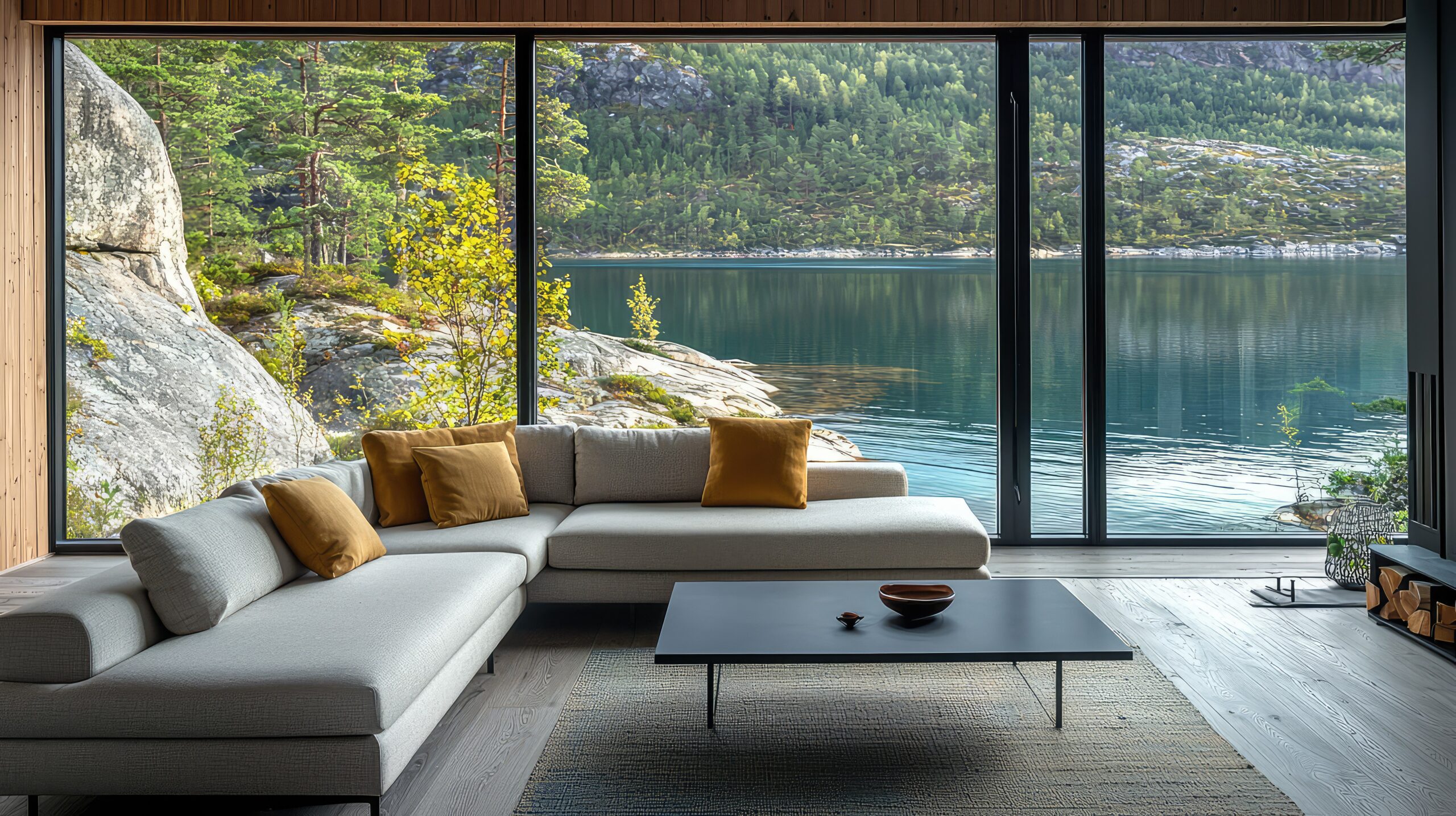
In the Hudson Valley, the relationship between a home’s interior and its landscape is one of the most powerful determinants of how the home feels to live in. This is a region of extraordinary natural beauty, forested hillsides, open meadows, river views, mountain silhouettes. And a home that turns its back on that landscape, or connects to it only through small, poorly placed windows, is a home that fails its site.
We design for indoor-outdoor connection deliberately and site-specifically. Where are the views worth framing? Where does the morning light fall on the landscape? Where is the terrain flat enough for a terrace that will actually get used? Where does the prevailing breeze come from in summer, and can we design an outdoor space that captures it?
We also think about transition, how you move from inside to outside, and how the architecture mediates that transition. A glass door that opens directly onto a terrace from the main living space creates one kind of connection. A covered porch that mediates between the conditioned interior and the open landscape creates a different one, a space that extends the habitable zone of the home into conditions that would otherwise be too hot, too cold, or too wet for unprotected outdoor use.
ArchDaily’s extensive coverage of residential architecture consistently highlights indoor-outdoor connection as one of the defining qualities of homes that achieve lasting appeal. The best residential projects don’t just sit on their sites, they extend into them, draw the landscape in, and create a continuous experience of being simultaneously sheltered and connected to the natural world.
In the Hudson Valley, that experience is one of the primary reasons people choose to build here. We design to honor it.
What Our Clients Tell Us About Living in Their Homes
The feedback we value most comes not at the completion of a project but a year or two later, when the novelty has worn off and the home has settled into the rhythms of daily life.
What we hear most consistently: the home works in ways they couldn’t fully anticipate during design. The morning light in the kitchen turns out to be one of their favorite things about the house. The mudroom entry has transformed how the whole family arrives home. The acoustic separation between the home office and the kids’ space has made working from home genuinely sustainable. The covered porch gets used ten months out of the year and has become the most-lived-in space on the property.
We also hear, occasionally, about the things that didn’t quite land, a storage location that turned out to be less convenient than it looked on paper, a window that catches afternoon sun in a way that wasn’t fully anticipated, a circulation path that works for adults but is slightly awkward for small children. We learn from these things. They refine how we approach the same questions on the next project.
Hudson Valley Magazine’s ongoing coverage of residential living reflects a regional appetite for homes that are deeply livable rather than merely impressive, homes that age gracefully with their owners and feel better to live in the longer you’re in them. That’s the standard we hold our work to.
How We Work: The Process Behind the Product
Our process as a modern home architect Hudson Valley practice is designed to produce exactly the kind of effortless livability we’ve been describing, and it’s worth being specific about how.
We work within the Design-Bid-Build model, which means we complete the design fully before construction begins. This isn’t just a delivery preference, it’s a quality commitment. A home that’s designed completely, with all its details resolved, all its adjacencies tested, all its structural and mechanical implications worked through, is a home that’s much more likely to be built right. The contractor isn’t improvising. The subcontractors aren’t guessing. Everyone is building from a complete set of instructions, and the architect, working for you, not for the contractor, is present during construction to verify that what’s being built matches what was designed.
We also stay in close dialogue with our clients throughout the design process. We share our thinking, explain our decisions, and invite pushback. The best designs we’ve produced have come from that dialogue, from clients who told us something wasn’t right, and from the conversation that followed about what would be better. Design isn’t a service we deliver to passive recipients. It’s a collaboration between people who know how they want to live and architects who know how to translate that knowledge into built form.
Thinking about your own project? Let’s talk. Reach out at wrightarchitectspllc.com.
Have a site you’re considering? We’d love to see it.
Reach out to us if you’re ready to explore what’s possible on your land.